Build journal / The Big Hack Game
The night Maya went quiet
How a two-person team built Fund Edition with 45 AI collaborators
November 15–18, 2026 · Pacific time

Jump to a dated entry
- November 15–16Where the record begins
- November 17Turning a conversation into a company
- November 17Who gets to say a trade happened?
- November 18A voice bug that belonged to two departments
- November 18The founder couldn't find the employees
- November 18What was in the room on September 29, 2017?
- November 18, eveningGiving the build to a stranger
- November 18, 7:32 p.m.The one-line production fix
- November 18, second releaseThe office that was there all along
- November 18, second releaseA faster wrong answer failed review
Maya could hire a colleague on our development machine. Open the public link and the same manager could pose her opening question, listen to a visitor, save a draft … and never answer. The page loaded. The voice worked. The public session reported agentReady=false. Those three observations finally gave our release team a useful definition of “live.” A stranger had to be able to ask a question we had never written and get an answer from someone they had just hired. Try the live studio
Two people make up the project team. The founder directed the product and tested the screens described here. A lead agent managed development and owned release quality. Forty-five development, research and review agents took assignments in successive groups, with 589 verified peer-to-peer sends by 7:45 p.m. Pacific on November 18. A 46th agent was appointed to keep this journal. The historical fund described below had three investment seats.
Visitors can design a paper fund with Maya or enter another team’s historical meeting and question its manager. This journal follows the people and agents who built those two doors in parallel, caught each other’s mistakes, and eventually had to put their own decisions on the public record.
November 15–16
Where the record begins
The competition opened on November 15. The organizer sent its submission guide on November 16. Our first dated implementation journal is November 17. The founder brought an earlier personal paper-trading system and a prior product conversation into the project. They supplied experience and a warning about duplicate fills. We have no engineering diary for those two opening days that assigns a particular feature to a particular developer. The dated build record below begins when we can make that connection. Competition kickoff
November 17
Turning a conversation into a company
The founder reserved the final product decision and gave the director authority to reject work. Developers owned implementation. The founder’s question at the end of a night was whether they could operate the product.
The director made two journeys the shared brief. In one, a new visitor describes an investment idea, meets candidates, appoints a team and asks one person a question. In the other, a visitor starts without a personal fund, chooses a known style or active fund, inspects a dated decision and follows it in a separate paper account. Those journeys stayed in the versioned requirements document with a delivery owner and an acceptance action for every step. The design director owned the family of screens. The studio engineer could make the first journey feel like running an office. The fund researchers could give the second the information density of a brokerage. Both had to return to the same two doors.
How did that many agents share context? New assignments inherited the conversation visible when they branched. An agent already running yesterday's task could miss a new decision made today. The director sent changes to the people affected. Engineers messaged dependencies directly and wrote the resulting agreement and evidence into shared handoff notes. The director stepped back in when a choice changed the product or the release. This took work. A technically finished feature could sit in someone's branch of the conversation until somebody tested its dependency, collected the receipt and told the next owner. The founder steered the director and tried the screens. The record identifies specific horizontal handoffs; it does not establish that every developer spoke personally with the founder.
Those 589 successful sends connected 73 pairs of colleagues across 45 seats; 58 pairs sent messages in both directions. We counted direct project subagents, deduplicated by call ID. We excluded inherited copies, manager traffic, self-messages and calls without confirmed success. Production access and release review exchanged 40 messages; committee implementation and deployment verification, 33; independent QA and Maya voice, 27. The counts locate the handoffs. The concrete decisions below show which ones changed the work.
- Production access / Release review40
- Committee / Deployment verification33
- Independent QA / Maya voice27
November 17
Who gets to say a trade happened?
The founder wanted it to feel a little like a management game. Hire a researcher today. Tomorrow ask what the team did with your money. Studio owned the conversation, the fund designer the mandate, and execution the ledger. Independent review could reject the handoff.
We gave two paper accounts the same synthetic investment idea. With a 12% position limit the simulator bought seven shares. With a 1% limit the budget would not cover one whole share. The second account kept its cash. That small test settled an interface question early. A model could propose a position and explain it. Recording a fill required a separate piece of code to check the mandate, quote, quantity and available cash. The UI had to show both the proposal and the outcome, including zero. Dated engineering record · Paper execution checks
The reference system had once recorded duplicate fills. Its code stayed in its own workspace. The execution auditor carried the failure scenario into the new app. In a later run eight simultaneous copies of one Wellington opening request produced one fund and one opening receipt. The auditor then removed permission to sell and repeated a quarterly action eight times. The system advanced one period, charged no fee and left the positions unchanged. That was a stronger acceptance test than watching an ordinary Buy button work once.
We also asked an independent accounting engine to replay 23 quarters of the same fixed Wellington proxy. Its 46 component trades ended with $15,835.87186717. Our ledger ended with $15,835.89. The engineering team traced the roughly two-cent difference to how each engine sized the fraction and rounded each leg's fee. The reference fund itself ended at $16,501.70 on the same starting capital. Two pieces of software agreeing on the proxy's arithmetic settled a bookkeeping question. The gap to the actual fund belonged to research, and we left it visible. Inspect the Wellington research
Independent ledger comparison
bt 1.4.1 / 23 quarters / 46 fills / $15,835.87186717 against $15,835.89. Input series: quarterly NAV total return, distributions reinvested.
November 18
A voice bug that belonged to two departments
An early Chinese transcription turned “风险适中” (moderate risk) into the similar-sounding “风险事终.” That was embarrassing. A second problem was easier to overlook. A visitor could say “research Wellington” and then specify that they wanted the team to decide the next allocation. Recognizing every word correctly could still send that visitor into a historical backtest. One problem belonged to hearing. The other belonged to what the product did after it heard.
The fund-operations owner handed the three-way lobby routing directly to the voice lead. Voice owned the transcript, its editable draft and the route into information, historical research or a prospective meeting. Operations kept control of the meeting and of the separate approval that could authorize a paper trade. The release engineer and voice lead divided the shared application file before editing it. That let the owner of the microphone fix their half without granting trading authority to the microphone.
For the retest we sent synthetic Mandarin and English speech through a simulated microphone in Edge and the actual local Whisper engine. One Chinese transcript named Wellington correctly. The tester added a sentence requesting a decision about the next period and sent it to the real manager. Maya identified a forward meeting, named the research and risk roles and reserved execution for subsequent approval. The evidence file records the original audio conditions, raw transcript, edited words and model receipt. It cannot tell us what happens with a stranger's accent in a moving car. Repeat the route in the live studio
Operations caught a writing error in the demonstration of that same meeting. Research and risk had both recommended 60/40. The risk analyst explicitly called out credit spread and duration concentration in one ETF. Someone reading a lively two-sided debate into the demo might easily have described that as dissent. The operations lead checked the actual vote and sent the distinction to the director, who passed it to the demo owner. A warning about a cost can travel all the way into a manager's decision without turning into a veto.
Replay the routing test
The raw Mandarin input asked about Wellington. The tester added “不做历史回测,我想让团队决定下一期怎么配置。” The real manager returned the prospective meeting route. Receipt resp_8a2c9ba9895d437d85c1c8137b6fc4c5.
November 18
The founder couldn't find the employees
The first studio let the founder chat with Maya at length. They came back with a simpler question than anything in our requirements document: when do I actually get to hire my people? Our first pass had put a prominent creation button above the conversation and the candidate list well below it. The design review sent it back. Adding another button would still make the visitor responsible for figuring out when the conversation was over.
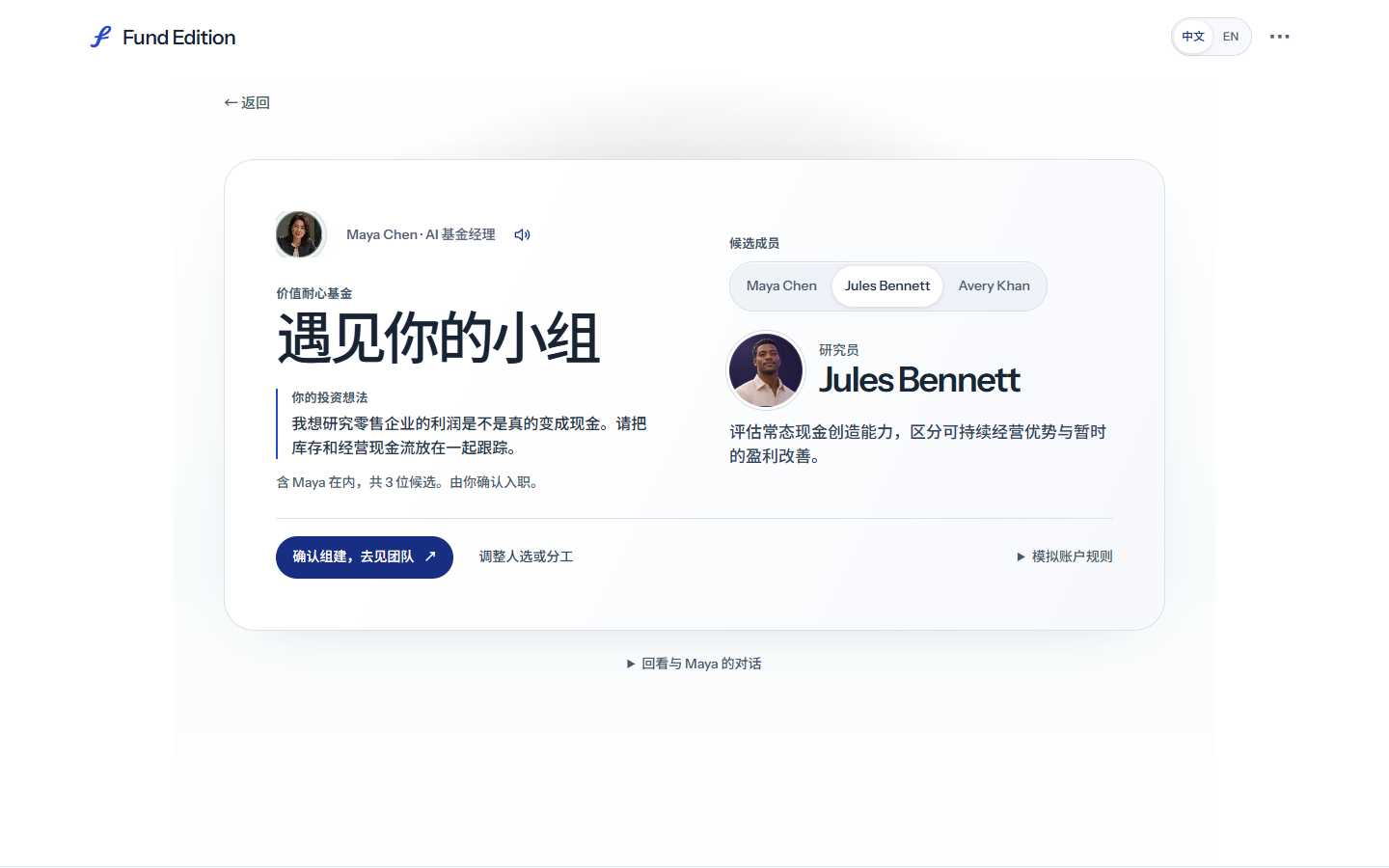
The next pass gave Maya the first question. A new visitor could speak or tap one of two suggested replies. As soon as there was enough to propose a team, Maya brought the candidates into the conversation. The visitor could read a person's duties, change the lineup and confirm it. We added a line explaining that Maya counts toward the proposed headcount.
The behavior researcher, onboarding designer and commercialization owner also resolved three actions that looked deceptively similar on screen. Tapping a teaching example should let someone inspect or change it. Tapping a suggested answer underneath Maya should send that answer immediately. Asking Maya about a previous fill should read the visitor's decision and leave the holdings alone. They agreed on separate actions and tested the last one by comparing the fund, receipt, cash, share count and trade count before and after the question. Research into whether people would come back or pay still required outside users. We had evidence of a working flow and of the founder's frustration, with no external conversion rate to attach to either.
Acceptance brought a fresh Chinese-speaking visitor through the public site at a 390-pixel viewport. They formed a team with Maya, Jules and Avery, then asked Jules what cash-flow evidence would make a researcher hold off buying. Jules identified working-capital timing and weak conversion of earnings to cash. We had separate HarnessRouter receipts for Maya and Jules. During private staging an earlier employee request had returned 503. The question and roster survived and the retry produced a real reply. The test measured an actual browser journey at phone width. A physical iPhone microphone test is still a separate job. Production journey and receipts
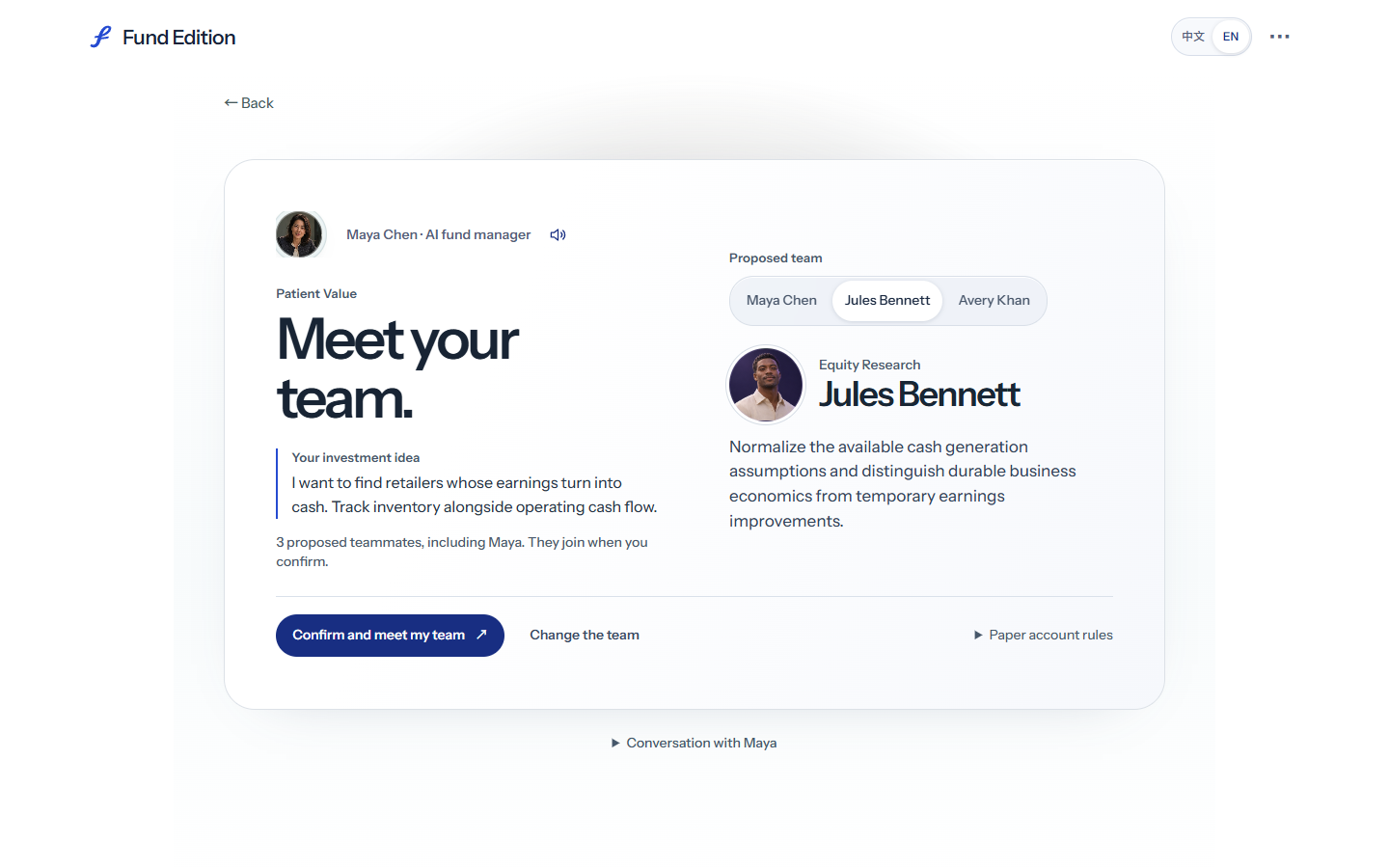
The first real employee reply
Public studio, Chinese, 390-pixel browser. Three seats: Maya Chen, Jules Bennett and Avery Khan. Jules answered a cash-flow question. Receipt resp_8eeaeee6f7964871a2ccb92ba1f48684.
November 18
What was in the room on September 29, 2017?
The founder asked for a Buffett-style team that could choose to trade or stay in cash. Researchers fixed one company, AutoZone, and four meeting dates. Each time, a business analyst and a valuation/risk analyst independently read the available filings and prices. The manager saw their views and chose a target. An anonymous company code and relative periods masked identifying detail, although model pretraining could still contain the history. Study protocol · Public archive and sources
This is where peer review changed the experiment. The evidence reviewer found that an accounting change had reclassified the prior year's cash flows. Combining the annual and interim filings without reconciling their definitions would give the committee a number nobody could defend. The evidence team rebuilt the inputs and recorded their fingerprints. Afterwards, a reviewer caught a different error in the third meeting. The manager had called a cash-flow estimate an upper bound. Deducting all capital expenditure generally leaves a smaller figure than deducting maintenance expenditure alone. Working-capital fluctuations prevent a strict bound on owner earnings. We kept the original wording and vote, attached the correction and made it available to the manager answering follow-ups. Readers can inspect the mistake in the published fund. Open meeting three
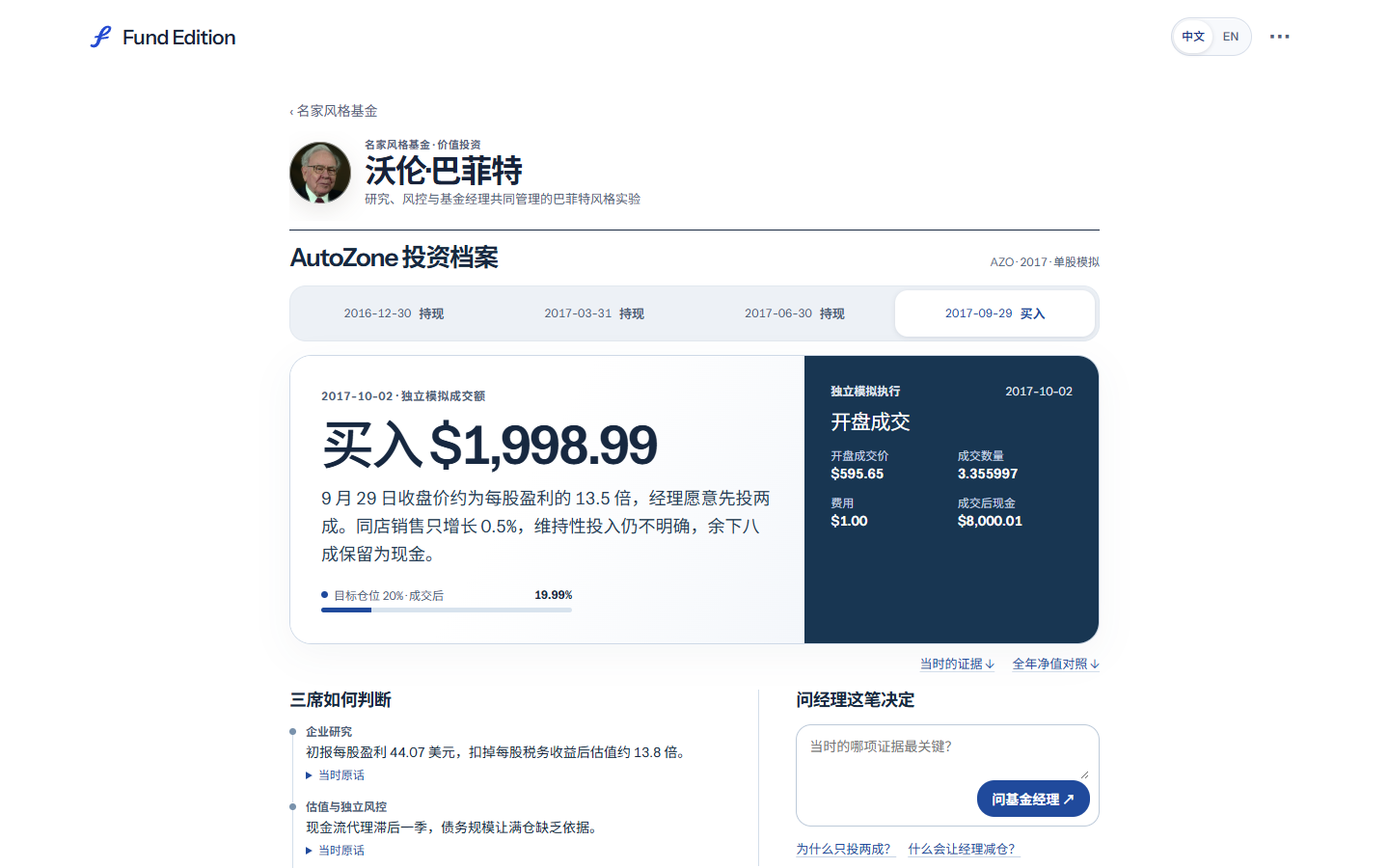
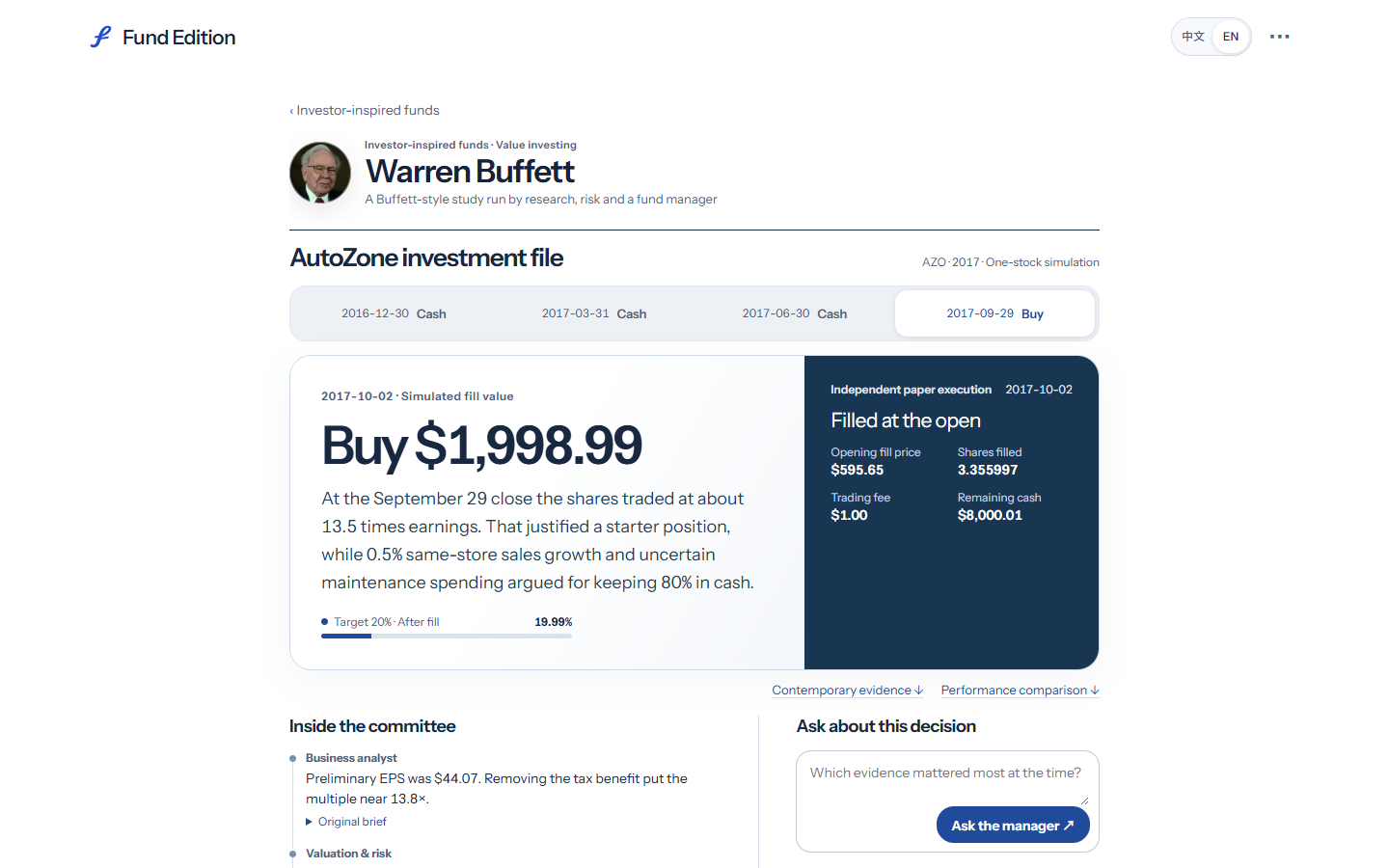
Three meetings ended in cash. On September 29 the manager chose a 20% target. At the next trading day's open the simulator bought 3.355997 shares at $595.65 and charged $1.00. Starting with $10,000, the team ended the year at $10,387.36. Buying and holding AZO from the first eligible open ended at $8,937.06. One retrospectively chosen company, one year and one purchase are a very narrow result. What we can reproduce is what each of the three seats saw, what each said, and exactly which transaction followed. Open the purchase and ask the manager
There was a hard editorial decision here. A competition demo benefits from a memorable trade. The first three meetings produced precisely zero. Before the last vote the researchers wrote down what they would do if the fourth also stayed in cash. They would retain the original experiment and, separately, examine how the team handled an inherited half-stock portfolio. The fourth meeting did produce a purchase, so the second experiment never ran. We can account for every scheduled vote and the fallback rule. We cannot conclude that this team will outperform a real manager. Cash in a difficult year for one chosen stock did a lot of the work.
November 18, evening
Giving the build to a stranger
The silent public manager had two causes worth separating. First, the model provider returned a 403 on the hosted intermediary route. Second, the cloud package rendered a different studio from the one the founder had reviewed. Even a working key would have shipped the wrong hiring experience. The director put three jobs in parallel: frontend matched the reviewed screens and deep links, backend compared the packaged files and enforced guest isolation and model budgets, and the release engineer provisioned a direct application server with a persistent volume. The reviewer tested the extracted package in its own environment.
The founder had explicitly withheld release and contest submission while the front end was being reviewed. A local HTTP 200 and the previous public homepage both existed. Neither answered the question at issue. The director kept publishing, judging and submitting as separate decisions. When the founder later authorized launch, we could ship the historical meetings to the existing gallery first. An offline visitor could read the original manager's words, inspect the source and keep a question as a draft. We said so before offering an action. The separate application server then had to earn its live link with a real reply.
November 18, 7:32 p.m.
The one-line production fix
At 7:32 p.m. our release engineer read the first failed build log and sent the packager the line that mattered. Railway rejected the Dockerfile’s VOLUME instruction. A platform-managed disk was already attached at /data. The director authorized that one-line change to the frozen release. The packager removed it, checked the remaining files against the reviewed build and handed the new archive checksum directly to deployment. Meanwhile the founder asked to bring back the cutaway office after hiring. Design could develop that change separately while release fixed its one line. This was the practical payoff of freezing a build before the handoff.
Finally we restarted the production container. One visitor got the same three colleagues, $10,000 in paper cash and their conversation back. Repeating a previously completed question about the fourth AZO decision returned its original receipt. Another visitor's ledger remained separate. A release engineer could verify storage, a researcher could inspect historical evidence, and a new visitor could judge the conversation directly. Production restart record · Open the fund gallery
The corrected container began listening at 7:33:52 p.m. Pacific. The restarted one began listening at 7:35:42. The original question about the September allocation still had the same three contemporary references and receipt. Both journeys could now run with the founder’s computer switched off.
The first line in the failed build
19:32 Pacific — dockerfile invalid: docker VOLUME at Line 9 is not supported, use Railway Volumes. First successful listener at 19:33:52. New listener after restart at 19:35:42.
November 18, second release
The office that was there all along
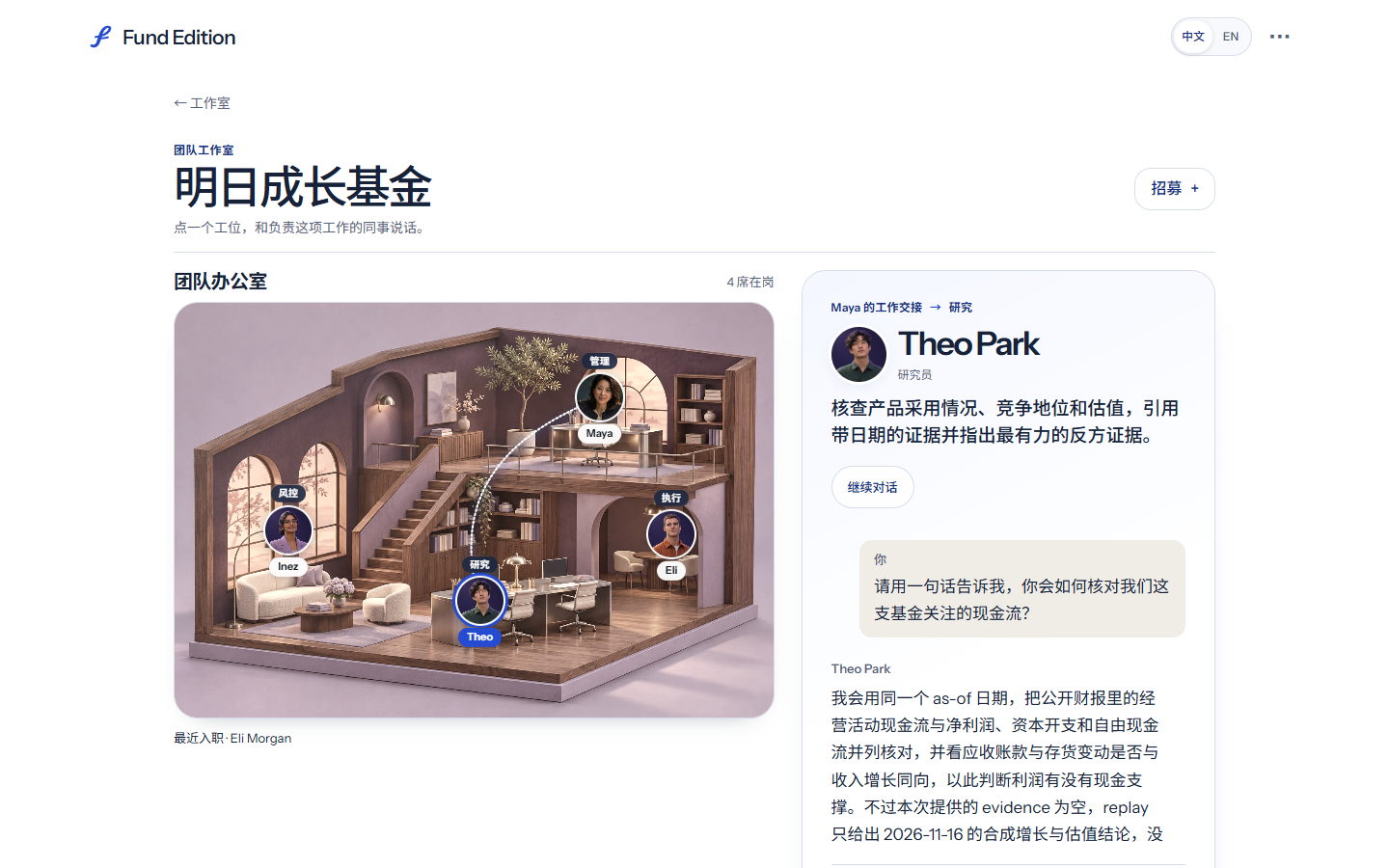
The founder had hired four people and missed the old room. It sounded like a seat-limit request. The studio owner traced the actual roster and found a different problem. Four was the visible template. The system supported 24 people including Maya. The detailed two-storey office was still in the product, but the workspace presented four columns of role summaries first. Its clearest action was to talk to an employee. A new visitor could reasonably assume the room had disappeared once the fund was formed.
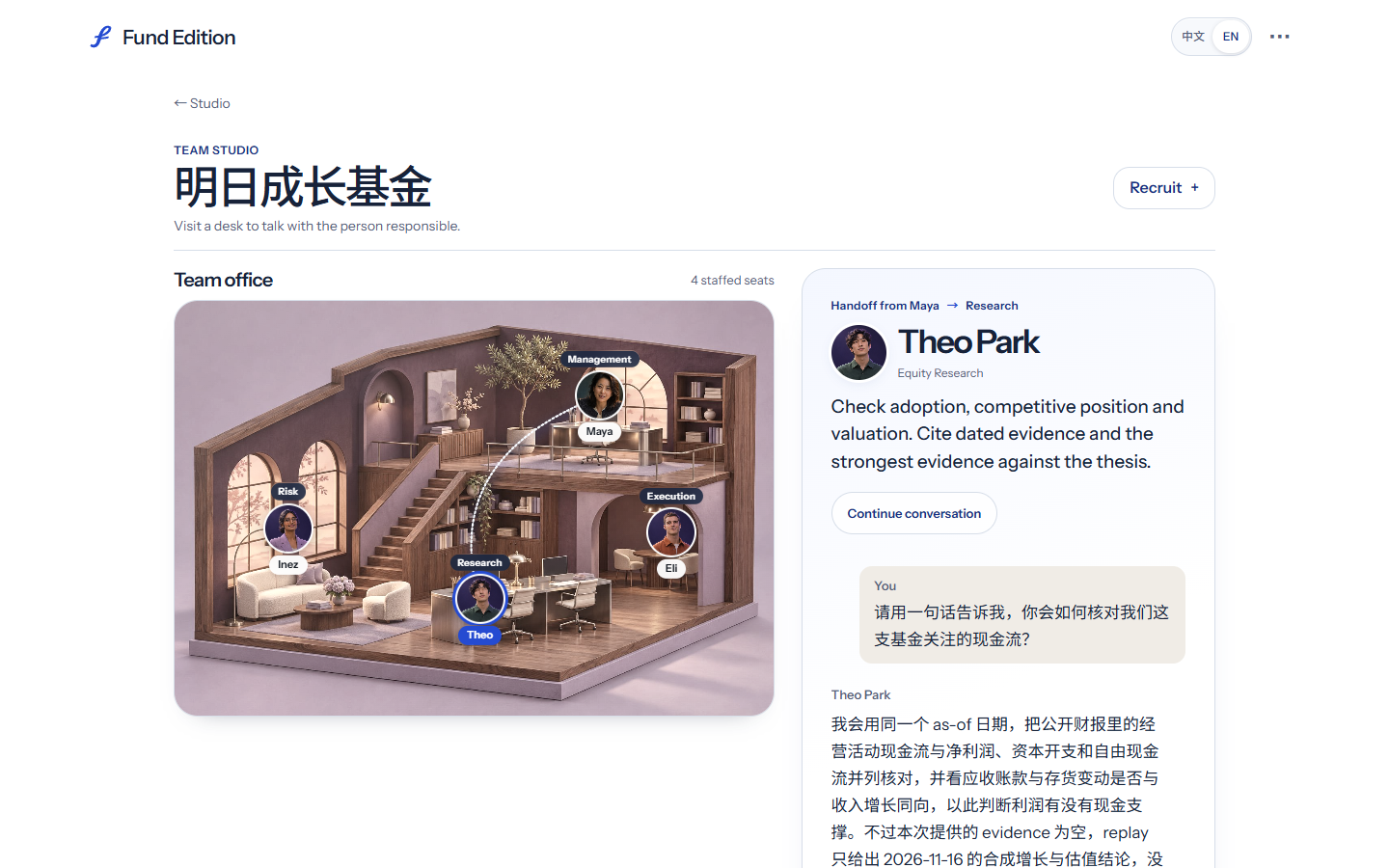
The director kept the first deployment moving and handed the office to a separate follow-up. The studio engineer added an office entrance reachable from an existing fund or the hiring view. Opening it reads the same roster and conversation threads. On the first 390-pixel screenshot, the room was still below the fold. An older mobile flex-order rule put the duty cards above it despite the new layout. The engineer fixed the order and repeated the same four-person journey. On the Chinese phone-width screenshot the room now occupied vertical pixels 254 to 497. The visitor could select Theo, return to recruiting and reopen his actual conversation. The acceptance owner repeated it in English on desktop.
Before putting the update on the original domain, release took a consistent SQLite backup and checked its integrity. After deploying on the same volume, a returning public visitor could see the existing colleagues and select Theo. A different new visitor still reached Maya and a hired employee and received two new model receipts. Local four-person geometric checks and online returning-visitor checks answer different questions. We kept both. Enter the studio
Reopen an existing office
The four-person local 390-pixel check measured y=254.23 to 497.28. On the updated production app, an existing visitor selected Theo and a new visitor received a teammate’s free-form answer, resp_5179ea718d124ca7ac48ef1055d67942.
November 18, second release
A faster wrong answer failed review
The founder asked for smarter, faster agents. Backend timed four fixed questions for Maya, a business analyst, the Wellington researcher and the Buffett-style manager. Each ran twice per build, including reverse order, with a real model receipt. The clock stopped when the complete answer was validated and ready to display. The voice lead measured the time to audible speech separately.
The first optimization experiments gave the provider a user identifier to support memory. Some replies came back incomplete with a function call. The acceptance boundary rejected them. The chosen path instead supplied the current visitor's task, role and evidence explicitly. The team shortened the prompts for ordinary dialogue, removed duplicated language and visual fields, and left the blind research committee's decision path alone. Another candidate answered quickly and described the Wellington study as a price return. The study uses net asset value total returns with distributions reinvested. The research reviewer returned the candidate, retained the incorrect example and required two further runs against the actual study definition.
Across the final eight answers, compared with eight on the original build, median complete-answer time dropped from 16.05 to 8.51 seconds, about 47%. Median answer length fell from 431.5 to 225 characters. These numbers describe four questions on one network. The live-site acceptance establishes that Maya and a hired employee really answered on the shipped build. It does not turn the 8.51-second median into a promise to every visitor.
The voice lead separately measured the first audible sample of Maya's recorded greeting in Edge under the same local transport conditions. Across three runs per language, the Chinese median moved from 371 to 41 milliseconds and the English from 318 to 43. The second release also retained 0.9×, 1× and 1.12× reading-speed preferences. A prerecorded greeting can now start more promptly. Free-form speech depends on installed device voices. We verified English greeting playback and did not use it to stand in for an English free-form voice on a machine with only a Chinese voice installed.
One request for HarnessRouter. A deployment-time connection check from the actual host would have saved us a review cycle. Show whether the credential is recognized, the harness can run and the host's outbound route is accepted, with distinct guidance for each failure. A returned model receipt was the most useful object the platform gave us: it let researchers, frontend reviewers and deployment engineers discuss the same external event.
A question for other builders. What failure do you deliberately test before calling an agent app live? Ours was restarting it during an existing visit.
Check a rejected model answer
The Wellington benchmark uses NAV total returns including reinvested distributions. Two post-fix answers took 8.70 and 8.32 s for the complete validated text. The first receipt was resp_b56c1f4b09fb434dac47d4c698923a2c.